|
|
|
|
.jpg) The town hall of Pleven
The town hall of Pleven
Pleven (Bulgarian: Плевен ["ple.ven]; historically known as Plevna in English) is the seventh most populous city in Bulgaria. Located in the northern part of the country, it is the administrative centre of Pleven Province, as well as of the subordinate Pleven municipality.
Internationally known for the Siege of Pleven of 1877, it is today a major economic centre of the Bulgarian Northwest and Central North and the third largest city of Northern Bulgaria after Varna and Rousse. |
|
|
Pleven Province or Plevenska Oblast (Bulgarian: Плевенска Област) is a province located in central northern Bulgaria, bordering the Danube river, Romania and the Bulgarian provinces of Vratsa, Veliko Tarnovo and Lovech. Pleven Province embraces a territory of 4,333.54 sq.km and a population of 310,449. The capital is the city of Pleven. |
|
.jpg) The central streets of Pleven
The central streets of Pleven
Pleven is located in an agricultural region in the very heart of the Danubian Plain, the historical region of Moesia, surrounded by low limestone hills, the Pleven Heights. The city"s central location in Northern Bulgaria defines its importance as a big administrative, economic, political, cultural and transport centre.
Pleven is located 170 km away from the capital city of Sofia, 320 km west of the Bulgarian Black Sea Coast and 50 km south of the Danube.
The river Vit flows near the town and the tiny Tuchenitsa river (commonly known in Pleven as Barata, literally "The Streamlet") crosses it.
The climate is temperate continental, with cold winters (down to –15°C) and hot dry summers (up to +35-44°C). |
|
History - Prehistory and antiquity |
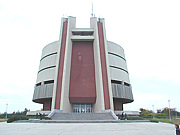 Pleven Panorama, one of the town"s best known sights
The earliest traces of human settlement in the area date from the 5th millennium BC, the Neolithic.
Numerous archaeological findings, among them the largest golden treasure found in Bulgaria, evidence for the rich culture of the Thracians, who inhabited the area for thousands of years.
In the beginning of the new era, the region became part of the Roman province of Moesia, and a road station called Storgosia arose near present-day Pleven on the road from Oescus (near modern Gigen) to Philippopolis (now Plovdiv). It later evolved into a fortress. One of the most valued archaeological monuments in Bulgaria from the period is the Early Christian basilica from the 4th century discovered near the modern city. |
|
|
During the Middle Ages, Pleven was a well-developed stronghold of the First and the Second Bulgarian Empire. When Slavs populated the region, they gave the settlement its contemporary name (Pleven is derived either from the Slavic word "plevnya" ("barn") or from "plevel", meaning "weed", which share the same root). The name was first mentioned in a charter by Hungarian king Stephen V in 1270 in connection to a military campaign in the Bulgarian lands. |
|
|
During the Ottoman rule, Pleven, known as Plevne in Ottoman Turkish, preserved its Bulgarian appearance and culture. Many churches, schools and bridges were built at the time of the Bulgarian National Revival. In 1825, the first secular school in the town was opened, followed by the first girls" school in Bulgaria in 1840, as well as the first boys" school a year later. Pleven was the place where the Bulgarian national hero Vasil Levski established the first revolutionary committee in 1869, part of his national revolutionary network. |
|
|
The city was a major battle scene during the Russo-Turkish War of 1877–1878 that Russian Tsar Alexander II held for the purpose of the liberation of Bulgaria. The joint Russian and Romanian army paid dearly for the victory, but it paved the path to the defeat of the Ottoman Empire in this war, and the restoration of Bulgaria as a state. It cost the Russians and Romanians 5 months and 38,000 casualties to liberate the town after four assaults in what was one of the decisive battles of the war.
The Encyclopaedia Britannica Eleventh Edition of 1911 concluded its lengthy entry on Pleven (transcribed as Plevna) with the memorable dictum:“ Plevna is a striking example of the futility of the purely passive defence, which is doomed to failure however tenaciously carried out… Victories which are not followed up are useless. War without strategy is mere butchery. |
|
|
The events of the Russo-Turkish War proved crucial for the development of Pleven as a key town of central northern Bulgaria. The town experienced significant demographic and economic growth in the following years, gradually establishing itself as a cultural centre of the region.
The Bulgarian Agrarian National Union, a leading interwar party representing the Bulgarian peasantry, was founded in the town in December 1899.
Prior to the Bulgarian orthographic reform of 1945, the name of the town was spelled Плвенъ (with yat) in Cyrillic. |
|
Demographics and religion |
|
According to statistical data, Pleven has a population of about 137,000 (or 124,000). The ethnic breakdown is 94% Bulgarians and 5% Roma, with other ethnic groups being represented by about 1%.
An overwhelming majority of 90% of Pleven"s residents are Eastern Orthodox Christian, while 5% of the population follows Islam. The Diocese of Nikopol, of which Pleven is part, is one of the two Roman Catholic dioceses in Bulgaria, and another 5% of the residents are Roman Catholic by faith, a significant number compared to other Bulgarian cities. |
|
.jpg) St George the Conqueror Chapel Mausoleum
St George the Conqueror Chapel Mausoleum
Pleven has three Eastern Orthodox churches, the Bulgarian National Revival St Nicholas Church (1834) that was constructed at the place of a chapel from the Second Bulgarian Empire, the St Paraskeva Church (1934) and the Holy Trinity Church, built in 1870 at the place of a church mentioned as early as 1523 and inaugurated by Exarch Antim I. As of 2005, a new Eastern Orthodox church is being built in the Strogoziya quarter.
The construction of a large Roman Catholic church of Our Lady of Fatima began in 2001. A mosque also exists in the town to serve the needs of the Muslim population, as well as a Methodist church that is situated on the site of the former local puppet theatre. |
|
|
A major centre of oil processing, metalworking, machinery construction, of light and food industries in Socialist times, after 1989 Pleven found itself in an economic crisis, with many of the major enterprises (such as the Plama oil refinery) closing or practically ceasing to work. However, the late 1990s and early 2000s saw a revival of light industry and the development of branches such as knitwear and store clothes production. Tourism, which had attracted many people from the Soviet Union prior to 1989, and had experienced a slump in the following years, is on the rise again. Other economic branches have also improved in the 2000s. The unemployment has fallen from 17% in 2000 to 7.5% in 2005 and continues to decrease.
The city has seen a number of major foreign investments in the late 1990s and early 2000s. Particularly noticeable is the mass construction of hypermarkets, with two Billa stores, a Praktiker outlet and a number of technology hypermarkets being opened as of 2006. In 2005, the investments in the economy of Pleven amounted to around 250 million leva (around ?125 million). |
|
|
|







 Sofia
Sofia